2.1 Foundation of my second Questionnaire/Sub-hypotheses
My research deals with the topic of how the Chekhov acting-method is suitable for work in jazz music context. For this I have designed a comprehensive questionnaire that resulted from the three different studies. It is based on the three techniques modified by Chekhov for jazz: gesture, atmosphere, and imaginary tool, which focus on three levels:emotional level, cognitive level and bodily level.
Another sub-hypothesis has emerged from this, which is the main message of this second questionnaire:
„The Chekhov method has a comprehensive effect on the authenticity and artistic personality of an or“ instrumentalist in the field of jazz music. „
2.2 Results of the Questionnaire
2.2.1 the participants
Fifteen participants (including myself) took part in this survey. Here I will only evaluate the results of the singers and musicians (14 participants).
9 of them are singers and 5 instrumentalists
aged 20-30
4 males and 10 females
All are Bachelor or Master students from the Conservatory in Maastricht. I put the group of participants from all studies together, who came in contact with the method: From the workshops, whether they have been there all the time or just once for example at the „Forrest Walk“ and the two duo partners from the duo sessions. Of course, this quantitative survey can only show possible trends and rather be seen as a preliminary examination!
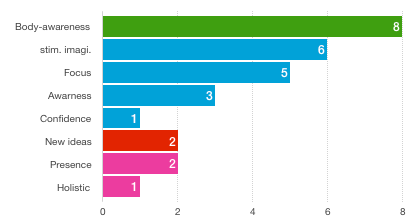
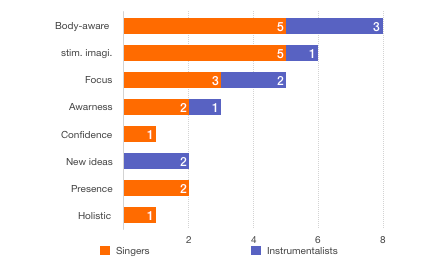
2.2.2 AO01 Which words do you associate with your Chekhov-experience?
My evaluation, in this case, shows that most words chosen in this multi-choice question where: „Body awareness“(28%), „stimulation of imagination“(21%) and „focus“ (18%).
The method is perceived by many participants regardless of whether musicians or singers as „physical“. The questions about the cognitive area had the most number of votes, but that was also the largest group of 5 options. It is interesting that the options for the emotional level „new idea“ were very low and only crossed by musicians (20%) While the „presence“ 18% seemed more important to singers.
Bodily level
emotional level
kognitive level
Mix of all levels
2.2.2. EFO Effect of the three Chekhov-Methods gesture, atmosphere and imaginary tool
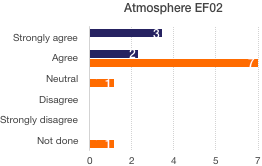
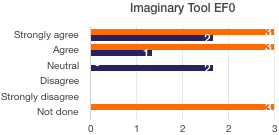
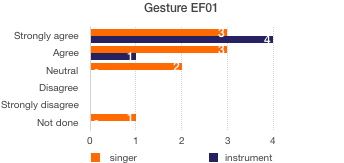
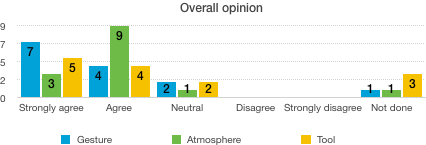
The agree answers show a clear answer to the tree methods (86%). Gesture (79%): Atmosphere 86% Imaginary Tool (64%). Interesting is that the gesture showed a little bit more impression on the musicians and the atmosphere on the singers, I thought it the other way around. But this is are of course small tendencies. I actually only used the imaginary tool intensively with the duo and the two gave the best rating from the instrumentalists. Despite the one time, we did the „tool“ in the workshops, the response from the singers was quite good. Interestingly, the atmosphere and the gesture did a little better with the instrumentalists than with the singers.
2.2.3. EFO4 The Chekhov-Method gave me useful tools for improvisation
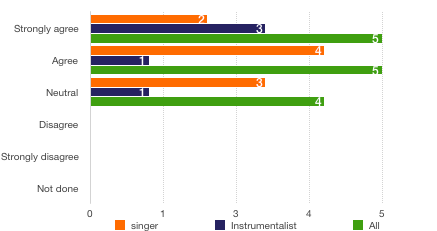
71% of all participants said that they agree, that the Method is a useful tool for improvisation in jazz (free-improvisation). When I look at the strong agreed answers the instrumentalists had 60% and the singers (22%)
2.2. CO01 Through the concentration on the gesture, atmosphere or imaginary tool I could better
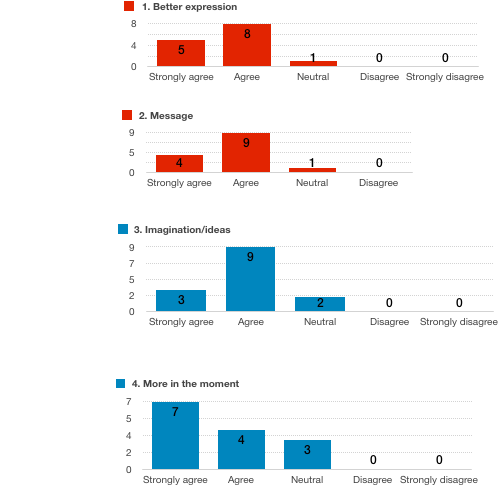
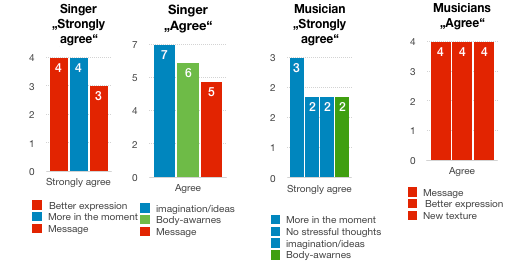
What catches the eye is, that there are two red emotional themes first: „Better expression“ and „Message“ (93%), which plays, in my opinion, an important role in the artistic personality. Then there are the following more blue topics („imagination“ 86 % and „more in the moment“ 78%) that speak for the „focus“: the imagination that challenges us to be in the moment. What you can clearly see is that the focus or the imagination expresses the message more clearly, as well as the expressiveness of the emotion, which is very interrelated. These answers are a good example to show this path from the brain to the emotion.
Singer versus Musicians
If I look at the „strongly agree“ answers, the singers could get a better connection to the message by focusing on the method and thus have a deeper emotional experience (78%). By the musicians, I noticed the blue cognitive areas have improved. Many also considered body awareness to be important.
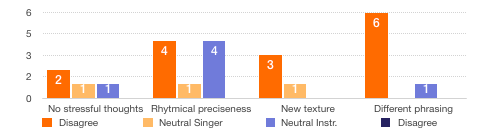
Where is Chekhov not working that good?
Perhaps the singers have had too little experience that the method can also be used to explore new sounds and textures and that the technique should improve phrasing. Rhythmic accuracy is the least associated with the method.
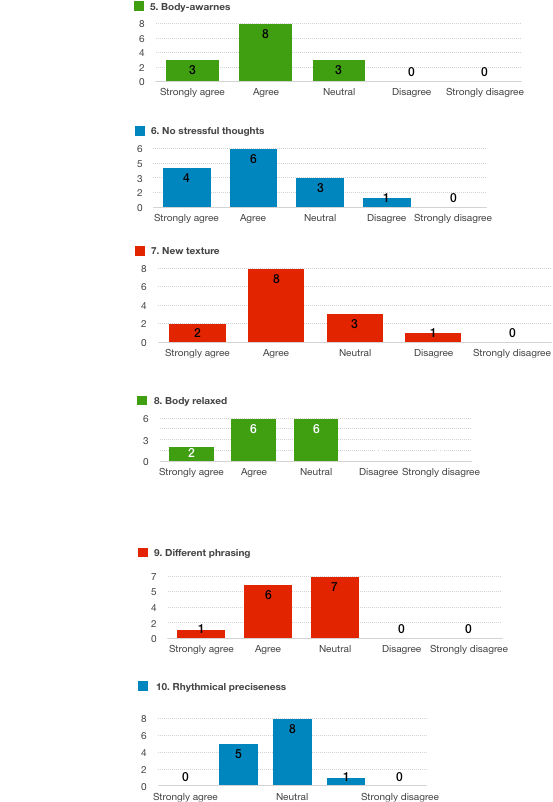
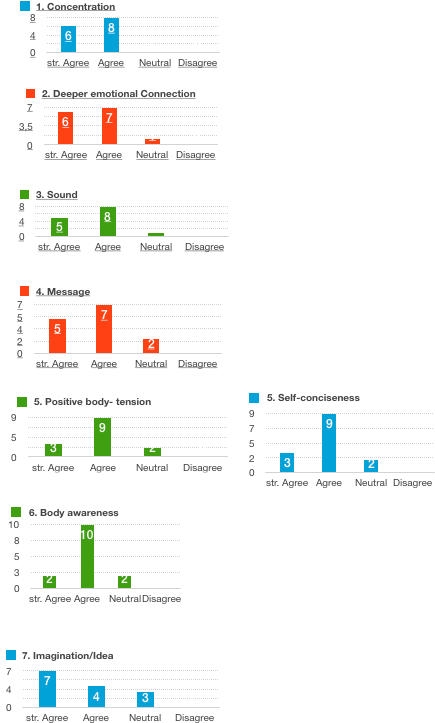
2.2. TO01 When I listened to the others I recognized a positive effect on
In this result, I sorted the answers from the most agree to the most disagree answers to see what the singers and musicians noticed the most from the outside.
Concentration is clearly the most mentioned (100% agreed from them 43% strongly) followed by deeper emotional connectionto a song (93% agreed from them 43% strongly ) is interestingly on the second place, although it was not mentioned in the associations.
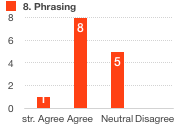
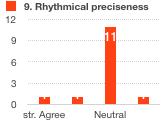
Which clearly has no effect on the performing was the better rhythm feel 86 % of the participants crossed neutral or disagree. More than half of the participants 64 % saw an effect on the phrasing, but it still not satisfying enough for me. But that could be a very interesting point for further research, because, in acting-world the Chekhov Method has a big influence in the kind of phrasing.
Difference between the groups
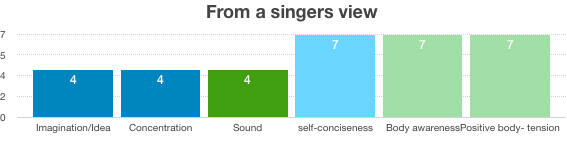
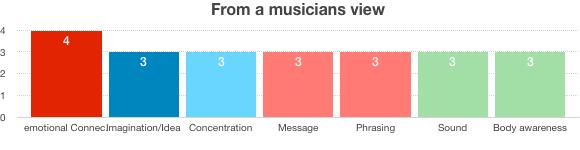
These are the best ratings for this category in the two groups singers and instrumentalists. Interesting is there is no emotional point in the singers group, they recognized from the outside more the kognitive and bodily changes. The instrumentalists saw a biggest difference in the performance on the emotional level, like emotional connection and message of a song.
2.2.NT01 The Chekhov-Method is a good starting point for ideas and suggestions for compositions.
It would be worthwhile to delve deeper into the topic of this special field in order to find good methods and processes that use Chekhov methods such as „the atmosphere“ ideally and structured for the basis of song and text writing and ideas.
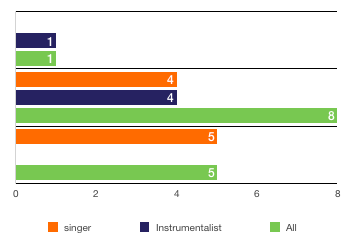
It was interesting to see that 100% of the instrumentalists agrees that they found the method interesting for getting ideas for compositions compared to the singers 44%.
2.2 SU01 I’m still using the exercises or ideas of the technique
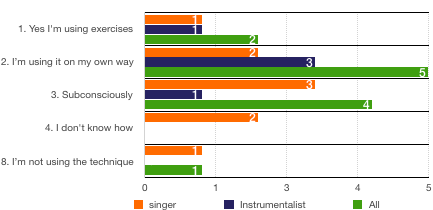
Most indicated that the method would continue to be used, although perhaps in its modified form or subconsciously. You can see a small tendency that instrumentalists can use this technique more consciously in their work, while singers may need more specific instructions.
- my own way 36 % subconscious 29%
- 79% using the technique as I suggest it or in there own way or subconsciously
- 21% don’t use the method or don’t know-how.
2.2.NO01 I am in need of …
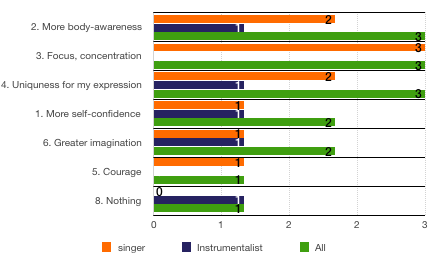
The singers ticked rather similar answers than the instrumentalists with more different needs.
33% of the singers are in need of more „focus / concentration“ exercises.
For 21 % of the participants are “body-awareness“ and„uniqueness of expression“ a need right now.
2.2. CU01 A method like the Chekhov-Method should have a regular place in the curriculum of a professional school of music
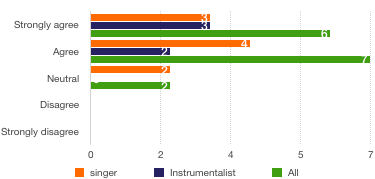
85% agreed (42% of them strongly) that the Chekhov Method should have a regular place in a curriculum of a professional school of music.
2.2. UA01 The Chekhov-Method gave me meaningful insights for my artistic development
This question was clearly answered with yes.
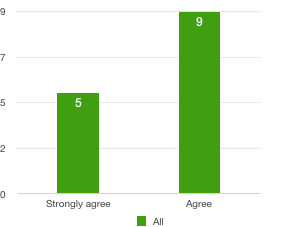
5 strongly agree – 9 agree (from 14)
60% of the instrumentalists 22% of the singer voted for „strongly agree
2.2.. UA02 The Chekhov-Technique has an impact on my uniqueness as an artist
Very clear result that supports my hypothesis. The participants vote:
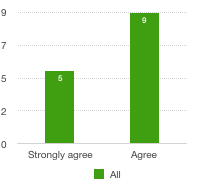
- 5 strongly agree
- 9 agree
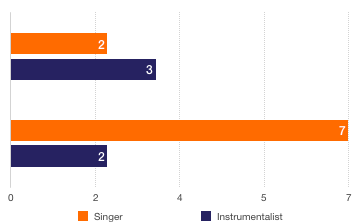
- 60% Instrumentalists 22% Singer voted for „strongly agree“
 Sebastian Stert